What does refuse meaning actually stand for in English? If you’ve ever felt unsure, this ultimate guide will give you a crystal-clear answer with examples you can relate to.
“Refuse” is a versatile, important word that can completely change meaning based on how it’s used. That’s why learning it the right way is critical for speaking and writing confidently.
Here, you’ll uncover the exact, simple, and proven explanation, along with powerful tips to avoid common mistakes. This exclusive, must-read guide is designed to give you a fast, easy, and effective understanding of refuse meaning today.
What Does “Refuse” Mean? (Definition & Origin)
The word refuse has two main meanings depending on how it’s used—and yes, that’s where most confusion starts.
Basic Definition
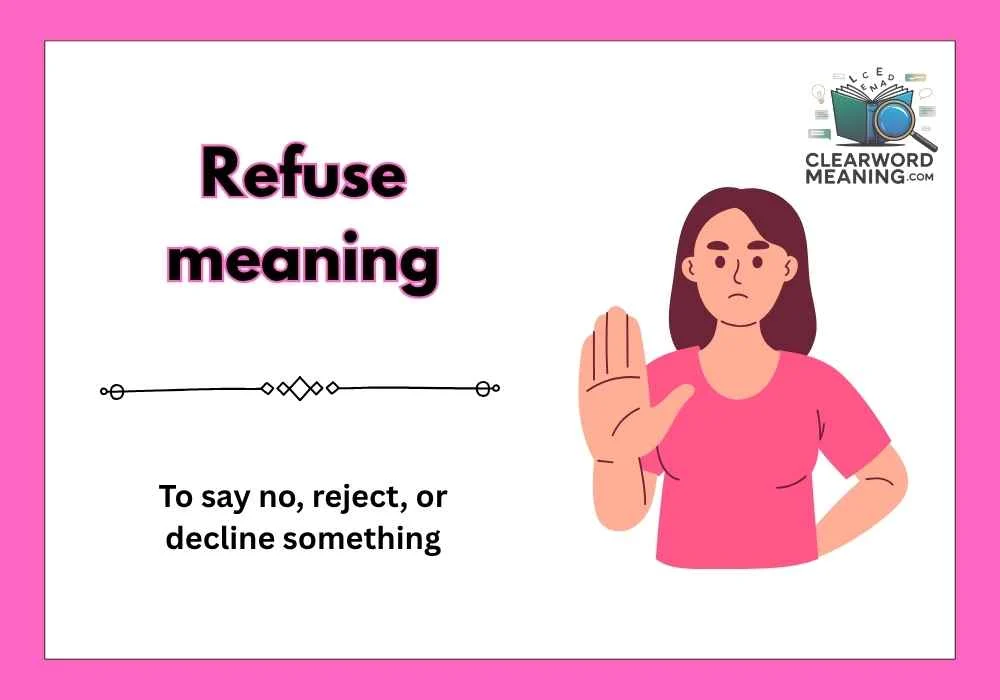
- Refuse (verb): To say no, reject, or decline something
- Example: I refuse to go out today.
- Refuse (noun): Waste or garbage
- Example: Please throw the refuse in the bin.
👉 In texting and online chats, refuse meaning in text usually refers to the verb form—basically, rejecting or declining something.
Origin of the Word
The word comes from Old French refuser, meaning “to reject or deny.” Over time, it became common in English with both meanings (reject + trash), but context always decides which one is being used.
How to Use “Refuse” in Texts or Chat
When it comes to refuse meaning in text, people mostly use it in a casual or expressive way to show strong disagreement or rejection.
Common Usage in Chats
Here’s how you’ll usually see it:
- Direct refusal
- I refuse to wake up early tomorrow 😴
- Dramatic or funny tone
- I refuse to believe this is happening 😂
- Playful exaggeration
- Nope, I refuse. Not doing it!
Where It’s Commonly Used
- WhatsApp conversations
- Instagram DMs
- TikTok comments
- Snapchat chats
- Gaming chats
💡 Pro Tip: In texting, tone matters! “Refuse” can sound serious or funny depending on emojis and context.
Examples of “Refuse” in Conversations
Let’s break down some real-life style examples so you fully understand refuse meaning in text.
Casual Chat Example
Friend 1: Let’s go to the gym at 6 AM
Friend 2: I refuse 😭
👉 Meaning: They strongly don’t want to go.
Funny Scenario
Friend: Pineapple pizza is the best
You: I refuse to accept this opinion 😂
👉 Meaning: You disagree in a playful way.
Serious Context
Boss: Can you work overtime tonight?
Employee: I’m sorry, I have to refuse due to personal reasons.
👉 Meaning: A polite but firm rejection.
Social Media Caption
- I refuse to settle for less 💯
- I refuse negativity in my life ✨
👉 These show strong personal boundaries or attitude.
Common Mistakes or Misunderstandings
Even though refuse meaning in text seems simple, people often mess it up.
Mixing Up “Refuse” with “Trash”
Some users think it always means garbage.
❌ That message is total refuse
👉 Sounds awkward unless you’re literally talking about waste.
✔ Better: That message is trash
Using It Too Seriously
Sometimes people use “refuse” in a way that feels too formal in casual chats.
❌ I refuse your invitation
✔ Nah, I refuse 😂
Misreading Tone
Without emojis, “refuse” can sound harsh.
- I refuse. → Might feel rude
- I refuse 😂 → Feels playful
💡 Always consider tone in texting!
Related Slangs or Abbreviations
To fully understand refuse meaning in text, it helps to know similar slang terms people use.
Popular Alternatives
- Nope – Casual no
- Nah – Relaxed refusal
- Pass – Declining something
- Hard pass – Strong refusal
- Nty – No thank you
- IDK but no – Indirect refusal
Gen Z Style Expressions
- I’m not doing that 😭
- Absolutely not 💀
- Yeah… I refuse
👉 These often replace “refuse” but carry the same vibe.
Internal Linking Suggestions
If you’re building a blog, you can link to:
- “What Does IDK Mean in Text?”
- “Meaning of TBH in Chat”
- “What is SMH in Texting?”
When Should You Use “Refuse” in Texting?
Understanding refuse meaning in text also means knowing when to use it.
Best Situations
- When you want to strongly say no
- When you’re being dramatic or funny
- When expressing boundaries
Situations to Avoid
- Formal or professional chats (unless polite)
- When tone might be misunderstood
- With people who don’t get sarcasm
Why “Refuse” Is Trending Again (Updated for 2026)
In 2026, texting culture is all about expression and personality. Words like “refuse” are trending again because:
- People love dramatic reactions
- It fits meme culture perfectly
- It’s simple but expressive
Example from recent chats:
- I refuse to function without coffee ☕
- I refuse to watch that ending again 😭
FAQs:
What is the exact refuse meaning in text?
The refuse meaning in text usually means to reject, decline, or say no to something, often in a casual or expressive way.
Is refuse a rude word in texting?
Not necessarily. It depends on tone. Adding emojis or context can make it sound playful instead of harsh.
Can refuse mean garbage in texting?
Technically yes, but in chats it almost always means to reject something, not trash.
How is refuse different from “nope”?
“Nope” is more casual, while “refuse” sounds stronger and more dramatic.
Why do people use refuse in memes?
Because it adds humor and exaggeration, making reactions feel more dramatic and relatable.
Conclusion
By now, you should fully understand refuse meaning in text and how to use it naturally in conversations. Whether you’re joking with friends, setting boundaries, or reacting dramatically, “refuse” is a powerful yet simple word that fits perfectly into modern texting culture.
Remember, context and tone are everything. Add emojis, keep it light when needed, and avoid sounding too formal in casual chats. With this guide updated for 2026, you’re ready to use “refuse” like a pro in any conversation.

I am the author, Brook, dedicated to creating clear and reliable content that informs and engages readers. With a passion for well-researched and valuable information, I focus on delivering content that is both easy to understand and practical. My goal is to build trust with my audience by providing consistent, accurate, and meaningful material. Whether writing for beginners or experts, I strive to make every piece insightful, engaging, and impactful.