Understanding family terms can get confusing fast especially when you hear phrases like “cousin once removed.”
If you’ve ever paused mid-conversation wondering what that actually means, you’re not alone. In today’s world of texting, social media, and casual chats, people often drop family terms without explanation, leaving others guessing.
In this updated for 2026 guide, you’ll learn exactly what cousin once removed meaning is, how to use it correctly, and how to explain it in the simplest way possible.
Whether you’re chatting with friends, filling out a family tree, or just curious, this article breaks it all down in a clear, human-friendly way.
What Does “Cousin Once Removed” Mean?
Let’s start with the basics.
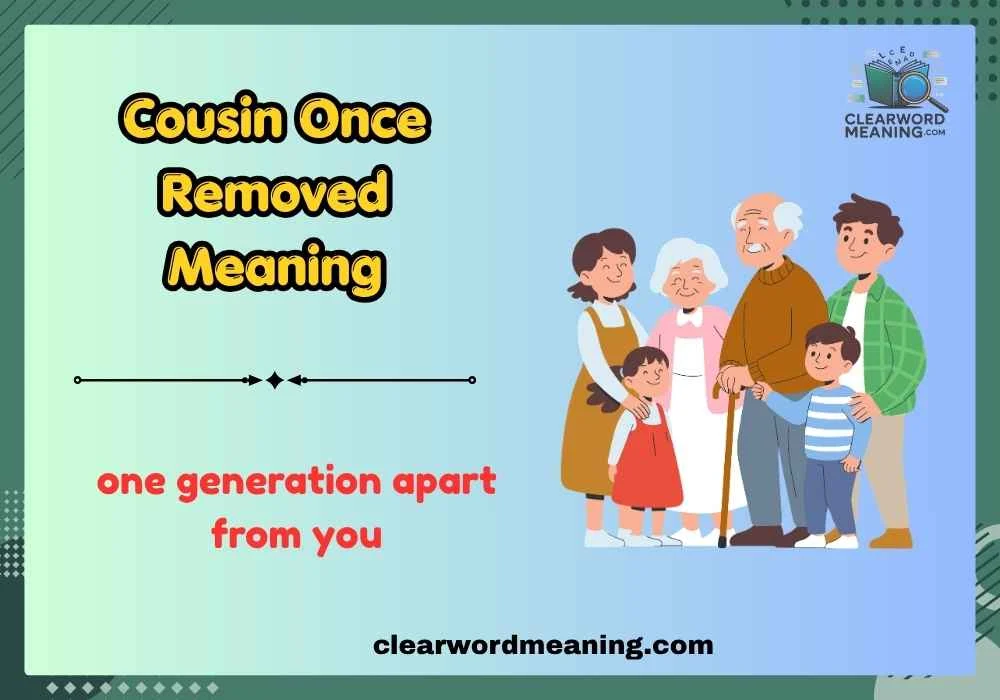
Cousin once removed refers to a cousin who is one generation apart from you.
👉 In simple terms:
- “Cousin” = same generation
- “Removed” = different generation
Easy Definition:
- Your parent’s cousin = your cousin once removed
- Your cousin’s child = also your cousin once removed
Why “Removed”?
The word “removed” doesn’t mean distant emotionally—it means removed by generations.
Quick Breakdown:
- First cousin → same generation
- First cousin once removed → one generation difference
- First cousin twice removed → two generations difference
💡 Pro Tip: The number (once, twice) tells you how many generations apart you are.
How to Use “Cousin Once Removed” in Texts or Chat
In modern texting or online conversations, people rarely say the full phrase unless they’re explaining family relationships. Instead, they might simplify it or casually mention it.
Common Contexts:
- Family discussions
- Genealogy chats
- Social media posts about relatives
- Wedding or reunion conversations
Example Usage in Texting:
- “She’s not my cousin, she’s my cousin once removed.”
- “My mom’s cousin? Yeah, that’s my cousin once removed lol.”
- “I just met my cousin’s kid—technically my cousin once removed 😅”
Shortened or Casual Versions:
People often say:
- “Distant cousin”
- “My mom’s cousin”
- “My cousin’s kid”
These are simpler but less precise than saying cousin once removed.
Examples of “Cousin Once Removed” in Conversations
Let’s make this super clear with real-life scenarios.
Example 1: Parent’s Cousin
Ali: Who is that lady at the wedding?
Sara: That’s my dad’s cousin.
Ali: Oh, so she’s your…?
Sara: My cousin once removed.
Example 2: Cousin’s Child
John: Is that your nephew?
Mike: Nope, that’s my cousin’s son.
John: So what does that make him?
Mike: My cousin once removed.
Example 3: Social Media Post
“Met my cousin once removed for the first time today—family trees are wild 😂”
Example 4: Funny Scenario
“I thought we were just cousins… turns out you’re my cousin once removed. Sounds like you got deleted from the family 😂”
Common Mistakes or Misunderstandings
Many people misunderstand this term, especially in casual conversation.
❌ Mistake 1: Thinking It Means “Distant Cousin”
Not exactly.
- “Distant cousin” is vague
- “Cousin once removed” is specific
❌ Mistake 2: Confusing It With Second Cousin
These are NOT the same.
- First cousin once removed = different generation
- Second cousin = same generation but different lineage
❌ Mistake 3: Assuming It Means “Removed from Family”
It doesn’t mean someone is cut off or unrelated. It’s purely about family structure.
❌ Mistake 4: Using It Incorrectly in Chat
People sometimes say:
- “My brother is my cousin once removed” ❌ (wrong)
Always remember:
👉 It only applies to cousin relationships across generations
Related Slangs or Abbreviations
While cousin once removed isn’t usually abbreviated in texting, here are some related modern slang or simplified terms people use:
Common Alternatives:
- Fam → short for family
- Cuz / Cous → casual for cousin
- Distant fam → informal version
Internet-Style Expressions:
- “Extended fam vibes”
- “Family but complicated 😂”
- “Somewhere in my family tree”
Internal Linking Ideas (for your blog):
You can link this article with:
- “What Does ‘Fam’ Mean in Text?”
- “Meaning of ‘Cuz’ in Chat”
- “Second Cousin vs First Cousin Explained”
How to Remember It Easily (Simple Trick)
Here’s a quick memory hack:
👉 “Removed = moved up or down a generation”
- Up → your parent’s generation
- Down → your child’s generation
So:
- Parent’s cousin = once removed
- Cousin’s child = once removed
Why This Term Still Matters in 2026
Even in the age of memes and short texts, understanding family terms like cousin once removed is still useful.
Where You’ll See It:
- DNA and ancestry websites
- Family tree apps
- Legal or inheritance discussions
- Cultural or traditional family systems
Plus, explaining it correctly can actually make you sound smarter in conversations 😄
FAQs:
1. What is a cousin once removed in simple words?
A cousin once removed is someone who is one generation above or below your cousin—like your cousin’s child or your parent’s cousin.
2. Is my cousin’s child my cousin once removed?
Yes ✅
Your cousin’s child is your cousin once removed.
3. What do I call my mom’s cousin?
Your mom’s cousin is your cousin once removed.
4. What is the difference between second cousin and cousin once removed?
- Second cousin → same generation
- Cousin once removed → different generation
5. Can “cousin once removed” be used in texting?
Yes, but people often simplify it to:
- “My cousin’s kid”
- “My mom’s cousin”
6. Does “removed” mean not close?
No ❌
It only refers to generation gap, not emotional closeness.
7. How do I explain cousin once removed quickly?
Say:
👉 “It’s my cousin but one generation apart.”
Conclusion
Understanding the cousin once removed meaning doesn’t have to be complicated. At its core, it simply describes a one-generation difference in a cousin relationship either upward (your parent’s cousin) or downward (your cousin’s child).
In today’s fast-paced digital world, people may not always use the exact term in chats, but knowing it helps you communicate more clearly and confidently—especially in family discussions or online conversations.
Now that you’ve got it down, you’ll never be confused again when someone mentions a cousin once removed. In fact, you might even be the one explaining it next time 😉

I am the author, Brook, dedicated to creating clear and reliable content that informs and engages readers. With a passion for well-researched and valuable information, I focus on delivering content that is both easy to understand and practical. My goal is to build trust with my audience by providing consistent, accurate, and meaningful material. Whether writing for beginners or experts, I strive to make every piece insightful, engaging, and impactful.