Texting, chatting, and even social media posts are full of words and abbreviations that we often skim over but have you ever stopped to think about what makes someone them? That’s where the word trait comes in.
Understanding the trait meaning isn’t just for psychology students it can actually help you decode personalities, improve communication, and even spot habits in your friends, colleagues, or online connections.
Updated for 2026, this guide dives deep into the trait meaning, how to use it in conversations, and even common mistakes people make when interpreting traits.
What Does “Trait” Mean? (Definition & Origin)
A trait is essentially a distinguishing quality or characteristic that defines a person, object, or even an animal. In simpler terms, it’s what makes someone or something unique.
- Origin: The word trait comes from the French word trait, meaning “feature” or “line.” Over time, it evolved into English as a term used in psychology and everyday conversation.
- Psychology vs Everyday Use: In psychology, traits are measured to understand personality (think “introvert” or “empathetic”). In casual chat, people might say, “Honesty is one of her best traits,” referring to a noticeable characteristic.
Key Point: A trait is not just behavior—it’s a part of someone’s identity or pattern of actions.
How to Use “Trait” in Texts or Chat
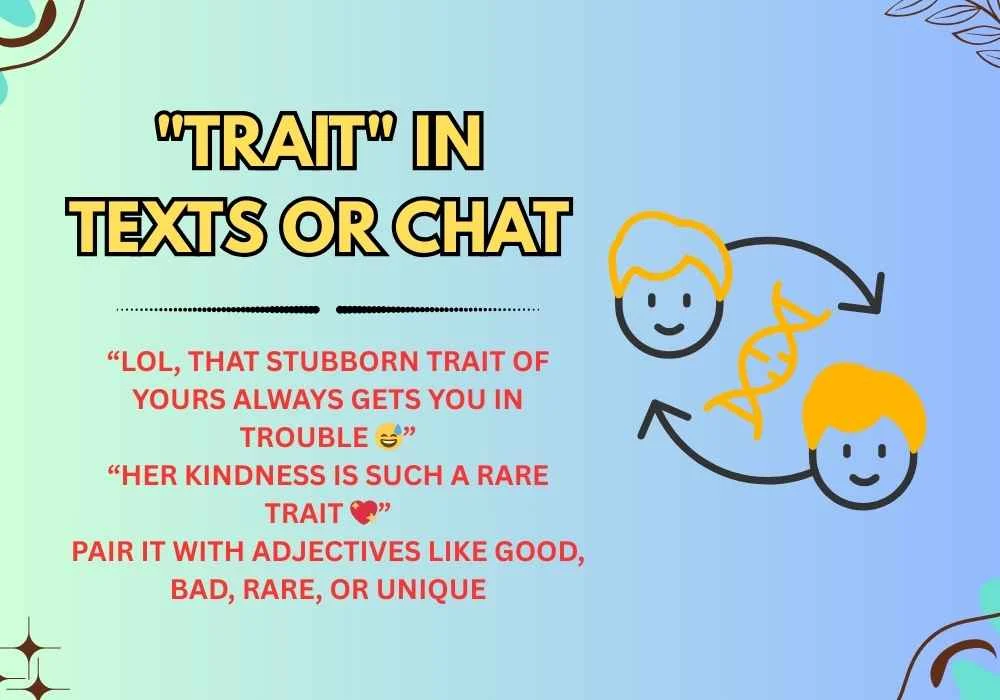
In modern texting and online chat, people rarely type long explanations. But knowing how to use trait can make your messages smarter and more meaningful.
- Examples in casual chat:
- “LOL, that stubborn trait of yours always gets you in trouble 😅”
- “Her kindness is such a rare trait 💖”
- Tips for using it naturally:
- Pair it with adjectives like good, bad, rare, or unique
- Use it to describe people, pets, or even fictional characters
- Avoid overusing it—too many traits in one sentence can sound formal
Pro Tip: Emojis can enhance the tone when mentioning traits in chats, making it more relatable.
Examples of “Trait” in Conversations

Seeing the trait meaning in action helps cement understanding. Here are some fun and realistic examples:
- Friends Chat:
- Friend 1: “I can’t believe he remembered my birthday again!”
- Friend 2: “That’s his caring trait shining through 😎”
- Work Chat:
- Colleague 1: “She’s always so punctual.”
- Colleague 2: “Yeah, punctuality is definitely one of her best traits.”
- Social Media Post:
- “Kindness is a trait we need more of in 2026 ❤️ #PositiveVibes”
These examples show how traits can be referenced casually, professionally, or socially.
Common Mistakes or Misunderstandings
Even though it’s a simple word, people often misuse trait. Here’s what to watch out for:
- Mistaking traits for actions: A one-time action is not a trait. Example: “Helping once doesn’t make someone kind—that’s a trait.”
- Overgeneralizing: Saying “All introverts hate parties” is wrong. Traits are tendencies, not absolutes.
- Confusing traits with skills: “Singing is a talent, not a trait.” Traits are inherent qualities, while skills can be learned.
Understanding these distinctions makes your usage smarter and more credible.
Related Slangs or Abbreviations
Even in 2026, slang has crept into the word trait—especially online. Here’s how people might reference it:
- “Vibe trait” – describing someone’s personality in terms of energy or aura
- “Rare trait” – used to highlight something admirable or unique
- “T traits” – shorthand some Gen Z users employ for text brevity (“T” = trait)
Internal Linking Suggestion: Consider linking to articles like “Personality Types Explained” or “Top 10 Traits of Successful People” to boost SEO.
How to Identify and Use Traits in Real Life

Knowing the trait meaning is one thing, using it is another. Here’s a practical approach:
- Observe behavior consistently – Traits are patterns, not one-off actions.
- Label accurately – Words like friendly, ambitious, creative work well in texts.
- Use in positive reinforcement – “Your patience is a trait I admire.”
- Adapt tone based on context – Formal in work, casual with friends.
By doing this, you’ll not only understand traits better but also improve how you communicate online and offline.
FAQs:
1. What is the difference between a trait and a habit?
A habit is a repeated action, while a trait is a deeper, defining quality of someone’s character.
2. Can traits change over time?
Yes, traits can evolve, especially with conscious effort, experiences, and personal growth.
3. Are traits always positive?
No, traits can be positive, negative, or neutral. Examples: kindness (positive), stubbornness (negative).
4. How do you use the word trait in a sentence?
“Honesty is a trait I truly value in friends.”
5. Are traits important in online communication?
Absolutely. Recognizing traits helps you understand people better and communicate effectively in chats, forums, and social media.
Conclusion
Understanding the trait meaning is more than just a vocabulary lesson—it’s a window into human behavior and online communication. By identifying traits in yourself and others, you can enhance relationships, improve your texts, and even make your social media posts more relatable.
Next time you’re texting, think about which traits you admire or notice in others. Use them naturally, add a bit of humor, and see how it changes the vibe of your conversations.

I am the author, Mitchell, passionate about creating engaging and reliable content that adds real value to readers. With a focus on clarity, accuracy, and insight, I aim to make complex topics easy to understand. I believe in delivering well-researched, practical information that builds trust and helps my audience make informed decisions. Every piece I write is crafted to be informative, meaningful, and impactful, reflecting my commitment to quality and consistency.