Unlock the full potential of perceptible meaning with this comprehensive, engaging, and practical guide.
Perfect for curious, intelligent, and motivated learners, it provides clear, accurate, and impactful explanations with examples that are easy to remember.
Elevate your vocabulary, improve communication, and gain confidence, clarity, and mastery in English. Make learning effective, fun, and memorable with insights designed to help you excel instantly.
What Does “Perceptible” Mean? (Definition & Origin)
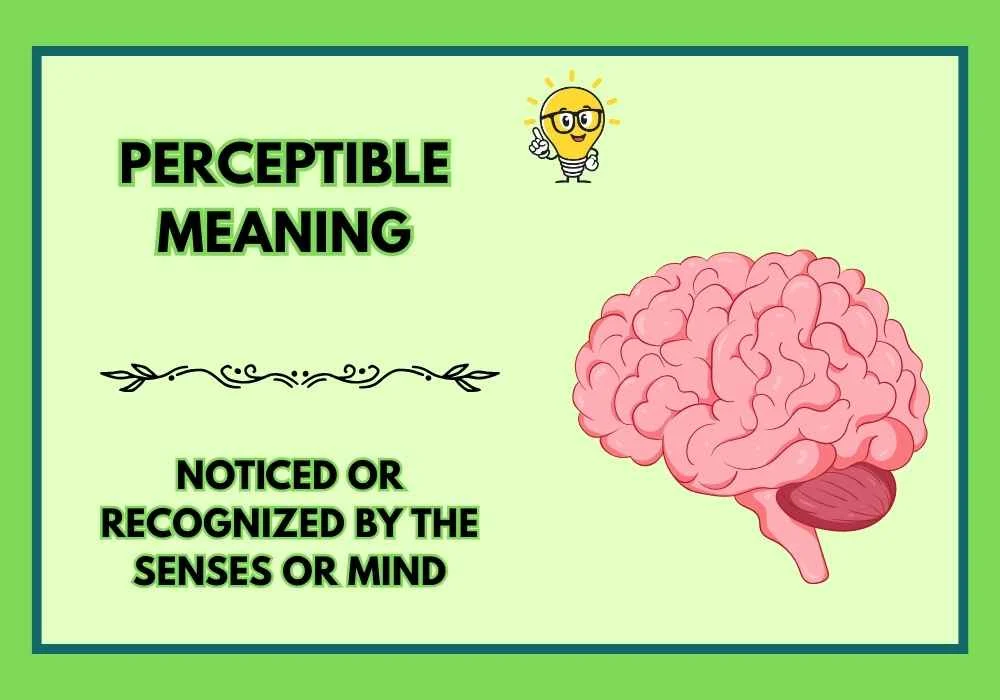
The word perceptible is an adjective used to describe something that can be noticed or recognized by the senses or mind. In other words, if something is perceptible, it’s clear enough to be detected.
Origin
- Derived from the Latin word percipere, which means “to perceive.”
- Entered the English language in the 15th century.
- Commonly used in formal and casual contexts alike, though in casual texting it may be replaced with simpler synonyms.
Example:
- “There was a perceptible change in her mood after the call.”
This sentence indicates that the change in mood was noticeable.
How to Use “Perceptible” in Texts or Chat

While perceptible isn’t the most common texting word, it can add clarity or sophistication to your messages. Here’s how you can naturally use it:
- Use it when pointing out observable changes or subtle differences.
- Works well in conversations about feelings, behavior, or environments.
- Suitable for professional chat apps, social media, or forums when precision matters.
Example in texting:
- Friend: “Did you notice anything different about the new design?”
- You: “Yes, there’s a perceptible improvement in the layout.”
Examples of “Perceptible” in Conversations

Here are some relatable scenarios where perceptible can be used:
- Casual Chat:
“There’s a perceptible shift in the weather today—it feels colder than yesterday.” - Social Media:
“The update made a perceptible difference in app performance. Loving it!” - Workplace Messaging:
“There’s a perceptible drop in engagement since last week’s campaign.”
These examples show how perceptible can enhance clarity, especially when describing changes or differences that are noticeable but subtle.
Common Mistakes or Misunderstandings

Even native speakers sometimes misuse perceptible. Here’s what to watch out for:
- Mistake: Using perceptible for something extremely obvious.
Correct Use: It should describe something noticeable, but not necessarily glaring. - Mistake: Confusing perceptible with perceptive.
Tip: Perceptive describes someone’s ability to notice things, while perceptible describes the thing that can be noticed. - Mistake: Overusing it in casual conversations.
Tip: Keep it natural; simpler synonyms like noticeable or detectable can sometimes work better in texting.
Related Slangs or Abbreviations
Even though perceptible is formal, it has some casual equivalents or related slang for texting:
- Noticeable → Used commonly in chats: “That’s a noticeable change!”
- Detectable → More formal, but works in academic or professional messages.
- Vibe shift → Modern, informal slang for subtle perceptible changes in mood or energy.
Example:
- “There’s a vibe shift in the group chat today” → A fun, relatable way to indicate a perceptible change.
FAQs:
What is the simplest way to explain perceptible?
It means something that can be noticed or observed, even if it’s small.
Can perceptible be used in casual texting?
Yes! While it’s formal, you can use it to describe subtle changes in moods, trends, or designs in your chats.
What is the difference between perceptible and perceptive?
Perceptible describes what can be noticed. Perceptive describes someone who notices things.
Are there any modern slang equivalents?
Yes! Words like vibe shift or phrases like “you can tell” convey a similar idea in casual chats.
How to use perceptible correctly in work messages?
Use it to highlight noticeable changes, trends, or subtle differences in reports, campaigns, or updates.
Conclusion
Understanding the perceptible meaning is more than just knowing a dictionary definition—it helps you communicate subtle changes clearly and effectively in texts, chats, and professional writing.
By using perceptible correctly, you can describe emotions, behaviors, or situations in a way that is both precise and engaging. Remember the common mistakes, explore casual equivalents, and practice using it naturally in your messages.

I am the author, Mitchell, passionate about creating engaging and reliable content that adds real value to readers. With a focus on clarity, accuracy, and insight, I aim to make complex topics easy to understand. I believe in delivering well-researched, practical information that builds trust and helps my audience make informed decisions. Every piece I write is crafted to be informative, meaningful, and impactful, reflecting my commitment to quality and consistency.