Are you struggling to understand the mean meaning in maths? Don’t worry! This guide will make it super easy for you to grasp. Understanding the mean meaning in maths is crucial for solving problems, analyzing data, and even making everyday decisions based on numbers.
Whether you’re a student, a teacher, or just curious, this article will give you a clear, simple, and practical explanation of what mean is, how to use it, and why it matters.
Updated for 2026, this guide includes real-life examples, common mistakes, and tips to use the concept confidently in your maths problems or daily life.
What Does “Mean Meaning Maths” Mean? (Definition & Origin)
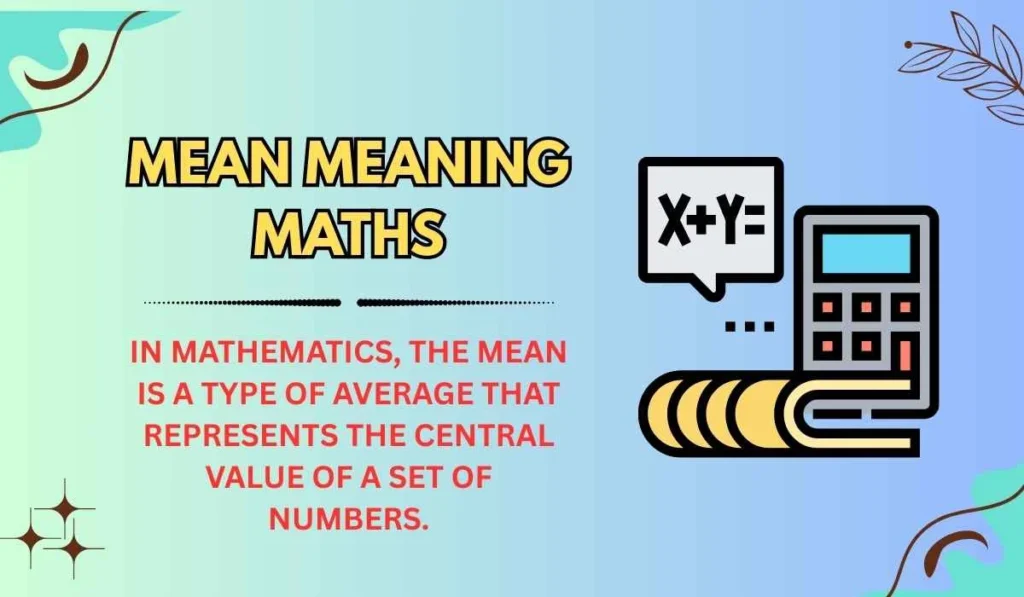
In mathematics, the mean is a type of average. Simply put, it is the sum of all numbers in a dataset divided by the number of values. It gives you a central value that represents the dataset as a whole.
Origin:
The concept of mean comes from the Latin word “medius,” which means “middle.” Over time, mathematicians adopted it to describe a central tendency or an average value in a collection of numbers.
Example:
If you have numbers 2, 4, 6, 8, the mean is:
(2 + 4 + 6 + 8) ÷ 4 = 20 ÷ 4 = 5
The mean helps to summarize large sets of numbers into a single, understandable figure, making it easier to analyze and compare data.
How to Use “Mean Meaning Maths” in Problems
Using mean in maths is simple once you understand the steps:
- Add all numbers in the dataset
- Count the total numbers
- Divide the sum by the count
Example:
Your test scores are 75, 80, 85, 90.
- Sum = 75 + 80 + 85 + 90 = 330
- Count = 4
- Mean = 330 ÷ 4 = 82.5
Tip: The mean is perfect for comparing sets of numbers, finding averages, and understanding data trends.
Examples of “Mean Meaning Maths” in Conversations
Here are some real-life scenarios where you might talk about mean in maths:
- Student to teacher: “What’s the mean of our class test scores?”
- Friend: “If we calculate the mean of our monthly expenses, we’ll know how much we spend on average.”
- Social media posts: “My weekly workout hours have a mean of 5 hours. Trying to improve next week!”
Notice how the mean is used to summarize data clearly in everyday situations.
Common Mistakes or Misunderstandings
Even simple concepts like mean meaning maths can confuse people sometimes. Here are the common mistakes:
- Confusing mean with median or mode: Mean is the average; median is the middle number; mode is the most frequent number.
- Ignoring negative numbers: Mean calculations include all numbers, positive and negative.
- Rounding too early: Always calculate the total first before rounding the final mean.
Example of a mistake:
Dataset: 2, 4, 6, 100
- Incorrect mean ignoring outlier: (2+4+6)/3 = 4
- Correct mean: (2+4+6+100)/4 = 28
Related Concepts and Variations
Understanding mean meaning maths often comes with exploring related concepts:
- Weighted Mean: Used when numbers have different importance.
- Geometric Mean: Useful for percentages and growth rates.
- Harmonic Mean: Common in speed and rate calculations.
Knowing these variations can make your maths skills more versatile and practical.
FAQs:
What is the easiest way to remember mean?
Think of mean as “adding everything and dividing by how many numbers there are.” It’s that simple!
Is mean always the best measure of average?
Not always. For skewed data with outliers, median might give a better picture.
Can the mean be a decimal?
Yes, the mean can be a fraction or decimal depending on the numbers.
Why is mean important in real life?
Mean helps summarize data for better understanding, from school grades to expenses and even business analysis.
How is mean different from median and mode?
Mean is the sum divided by count, median is the middle value, and mode is the most frequent value.
Conclusion
Understanding the mean meaning in maths is essential for students, teachers, and anyone working with numbers. It helps you summarize data, make comparisons, and solve everyday problems efficiently. Remember the steps: sum all numbers, count them, and divide—simple yet powerful!
Practice calculating the mean with your own data, notice patterns, and avoid common mistakes like ignoring outliers. Updated for 2026, this guide ensures you have the latest examples and explanations to confidently use mean in maths.

I am the author, Mitchell, passionate about creating engaging and reliable content that adds real value to readers. With a focus on clarity, accuracy, and insight, I aim to make complex topics easy to understand. I believe in delivering well-researched, practical information that builds trust and helps my audience make informed decisions. Every piece I write is crafted to be informative, meaningful, and impactful, reflecting my commitment to quality and consistency.