Curious about darwinism meaning and why it keeps popping up in conversations, texts, or online debates? You’re in the right place! Darwinism meaning goes far beyond a textbook definition—it’s a concept that shapes how we understand evolution, survival, and natural selection.
Whether you’ve seen it in casual chats, social media threads, or academic discussions, knowing the exact meaning helps you sound informed and confident. In this guide, we’ll break down darwinism meaning, show real-life examples of its usage, and highlight common mistakes people make when using it in discussions or texts.
Updated for 2026, this article ensures you’ll stay ahead of the curve with the most accurate, relatable, and modern explanations.
What Does “Darwinism” Mean? (Definition & Origin)
Darwinism is the theory of biological evolution developed by Charles Darwin, emphasizing that species evolve through natural selection—the process where organisms better adapted to their environment tend to survive and reproduce.
- Origin: The term comes from Charles Darwin’s groundbreaking 1859 book, On the Origin of Species.
- Core Idea: Survival of the fittest—organisms compete for resources, and the strongest or most adaptable thrive.
- Modern Context: Beyond biology, “darwinism” can refer to ideas or practices in society, economics, or tech that mimic this survival principle.
In short, darwinism meaning isn’t just science—it’s about adaptation, change, and evolution, which is why it’s often referenced in modern discussions.
How to Use “Darwinism” in Texts or Chat
Using darwinism in a casual chat or discussion can make you sound smart and informed, but context is key. Here’s how:
- Academic Chat: “We were discussing darwinism meaning in our biology class today.”
- Social Media: “The new tech startup scene is basically darwinism in action—only the strongest survive.”
- Everyday Texts: “Haha, that’s pure office darwinism! Who gets the promotion?”
Pro Tip: Pair it with words like evolution, survival, or adaptation to make your point clear.
Examples of “Darwinism” in Conversations
Real-life examples make it easier to grasp darwinism meaning:
- 1 Example: Friend 1: “Did you see how only a few animals survived the harsh winter?”
Friend 2: “Classic darwinism!” - 2 Example: Social media post: “Darwinism at the grocery store—last cart, first come, first served.”
- 3 Example: Workplace joke: “New interns figuring out the system? Total darwinism!”
These examples show how the term is flexible and can be adapted humorously or seriously in chats.
Common Mistakes or Misunderstandings
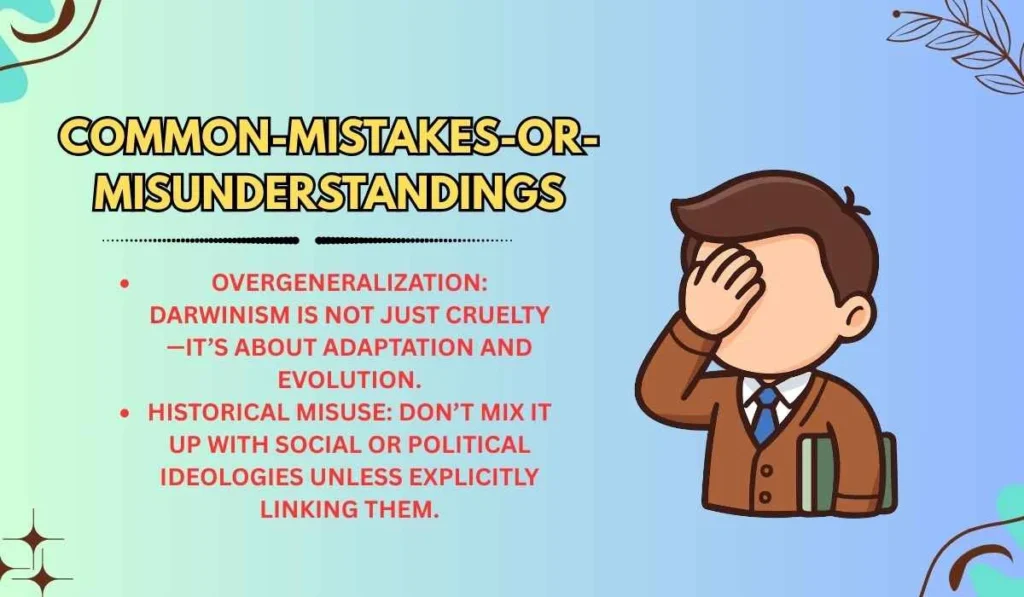
Many people misuse darwinism, thinking it’s just about “survival” without context. Avoid these pitfalls:
- Overgeneralization: Darwinism is not just cruelty—it’s about adaptation and evolution.
- Historical Misuse: Don’t mix it up with social or political ideologies unless explicitly linking them.
- Wrong Pronunciation or Spelling: It’s dar-win-ism, not dar-ween-ism.
Related Slangs or Abbreviations
While darwinism itself isn’t an acronym or text slang, it’s often linked to modern abbreviations or shorthand online:
- IRL (In Real Life): “IRL darwinism is brutal in corporate jobs.”
- FYP (For You Page): Seen on TikTok memes about survival and evolution.
- LOL / LMAO: Used when joking about “survival of the fittest” in funny contexts.
These help connect darwinism meaning to real-life texting or chat scenarios.
FAQs:
What does darwinism mean in simple words?
Darwinism means evolution through natural selection—the idea that only the best-adapted organisms survive.
Is darwinism still relevant today?
Absolutely! Darwinism is applied in biology, social theories, and even tech or business contexts to describe adaptation and survival.
Can I use darwinism in casual texts?
Yes, just use it humorously or metaphorically to describe situations where “only the fittest survive.”
How did darwinism get its name?
It’s named after Charles Darwin, who proposed the theory of natural selection in 1859.
What’s the difference between darwinism and evolution?
Darwinism is a specific theory of evolution focused on natural selection, while evolution is the broader concept of species changing over time.
Conclusion
Understanding darwinism meaning helps you use it correctly in conversations, texts, and online chats. It’s more than a science term it’s a lens to view adaptation, competition, and survival in everyday life.
By learning its origin, usage, and common mistakes, you’ll confidently apply darwinism in multiple contexts. From serious debates to casual jokes, this term stays relevant for 2026 and beyond.

I am the author, Mitchell, passionate about creating engaging and reliable content that adds real value to readers. With a focus on clarity, accuracy, and insight, I aim to make complex topics easy to understand. I believe in delivering well-researched, practical information that builds trust and helps my audience make informed decisions. Every piece I write is crafted to be informative, meaningful, and impactful, reflecting my commitment to quality and consistency.