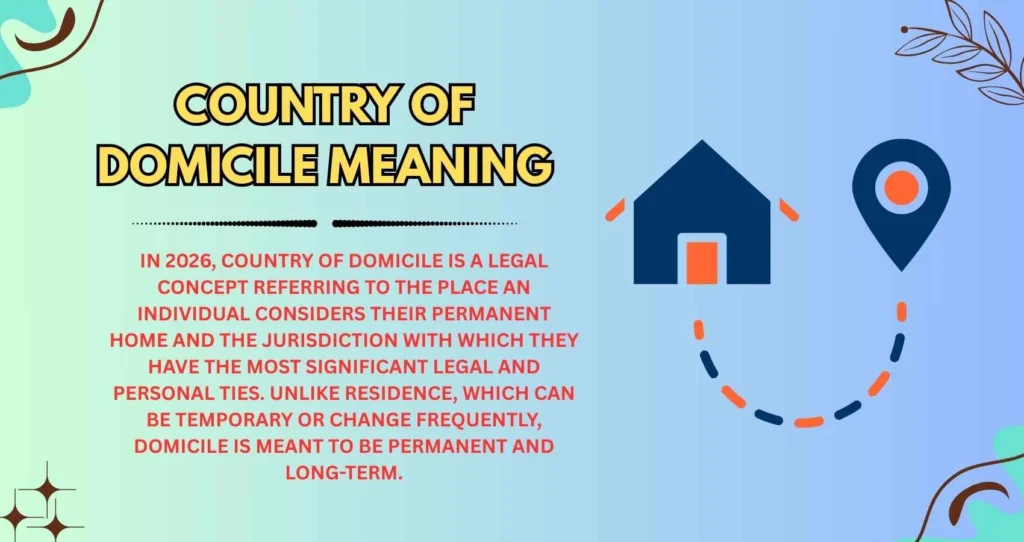
Understanding legal or financial terms can be tricky, especially when it comes to phrases like country of domicile meaning. If you’ve ever filled out forms, applied for visas, or dealt with taxes, you might have stumbled upon this term and wondered,
“What does it really mean?” In this guide, we’ll dive deep into the country of domicile meaning, explore its origin, show how it’s used in everyday contexts, and share tips to avoid common mistakes.
By the end, you’ll confidently understand this term and know exactly how to use it correctly—updated for 2026.
What Does “Country of Domicile” Mean? (Definition & Origin)
The country of domicile meaning is often confused with your nationality or residence, but it’s distinct. In simple terms:
- Your domicile is the country you consider your permanent home.
- It doesn’t change just because you move temporarily for work, study, or travel.
- Legally, it affects taxation, inheritance, and government benefits.
Origin: The term comes from Latin domicilium, meaning “home” or “residence.” Historically, it referred to the place where you were legally considered to live, regardless of where you were physically present.
Quick distinction:
| Term | Meaning |
|---|---|
| Nationality | Your legal citizenship |
| Residence | Where you live temporarily |
| Domicile | Your permanent legal home |
How to Use “Country of Domicile” in Texts or Chat
Yes, even formal terms can pop up in casual texts—especially among expats, students abroad, or in finance-related chats. Here’s how you might see it:
- Professional chat: “Please confirm your country of domicile for the tax forms.”
- Social media: “Anyone else stuck figuring out their country of domicile meaning for the new app?”
- Messaging with friends: “I need my domicile country info for the visa form, lol!”
Pro Tip: Always use it when discussing legal, tax, or financial matters, not casually in daily conversation, unless joking among peers.
Examples of “Country of Domicile” in Conversations
Here are some real-life examples:
1 Scenario – Tax Filing
Alice: “Hey, for this form, do I put my UK address?”
Bob: “No, you need your country of domicile, which is where your permanent home is registered.”
2 Scenario – Visa Application
Sarah: “They asked for my country of domicile. Is it my current city?”
John: “Not really, it’s the country you legally consider home.”
3 Scenario – Social Media Query
User1: “Can anyone explain country of domicile meaning?”
User2: “Basically, your legal home, not where you’re temporarily living.”
Common Mistakes or Misunderstandings
Many people confuse domicile with:
- Current residence: Just because you live somewhere temporarily doesn’t make it your domicile.
- Nationality: Your citizenship isn’t always your domicile.
- Tax residence: Sometimes similar, but not always the same.
Tip: Always check legal documents or government guidance when listing your country of domicile to avoid errors.
Related Slangs or Abbreviations
While country of domicile isn’t slang, in informal chats or texting, people often abbreviate it:
- CoD – Country of Domicile (common in financial forums)
- DomCountry – Casual shorthand in social media threads
- HomeCountry – Friendly version in messages
Usage example:
“Hey, don’t forget to fill in your CoD for the online form.”
Updated for 2026: Practical Tips for Using the Term
- Check your legal documents – passports, tax forms, or contracts often ask for domicile.
- Be consistent – always use the same country unless you legally change your domicile.
- Ask experts – accountants or lawyers can help clarify if you’re unsure.
- Remember online forms – many apps, banks, and services now require your country of domicile.
FAQs:
What is the difference between domicile and residence?
Domicile is your permanent legal home, while residence is where you currently live temporarily.
Can your domicile change?
Yes, but it usually requires legal steps, like moving permanently with intent to stay.
Does domicile affect taxes?
Absolutely, it can determine tax obligations, inheritance laws, and access to benefits.
Is nationality the same as domicile?
No. Nationality is citizenship; domicile is your legal permanent home.
How do I know my country of domicile?
Check your legal records, tax filings, or official documents. It’s where you are legally considered to reside permanently.
Conclusion
Understanding the country of domicile meaning is crucial for legal, financial, and administrative purposes. It’s not the same as your current residence or nationality, and using it correctly can save you from tax issues, application errors, or legal confusion.
Remember to always verify your domicile country on official forms and applications. Share your favorite text abbreviation or legal term in the comments, and let’s make navigating modern language and formal terms easier together!

I am the author, Mitchell, passionate about creating engaging and reliable content that adds real value to readers. With a focus on clarity, accuracy, and insight, I aim to make complex topics easy to understand. I believe in delivering well-researched, practical information that builds trust and helps my audience make informed decisions. Every piece I write is crafted to be informative, meaningful, and impactful, reflecting my commitment to quality and consistency.