When people search “arbitration meaning”, they’re usually dealing with something more serious than just vocabulary. It often shows up in contracts, business disputes, job agreements, or legal situations where two sides don’t agree and need a decision.
But arbitration is not as complicated as it sounds.
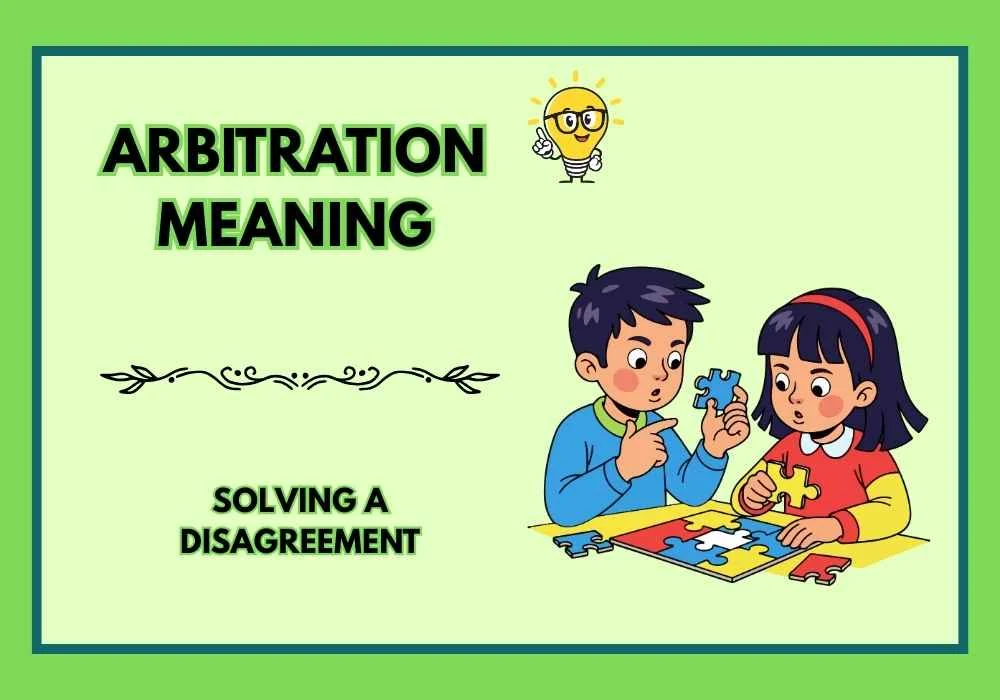
In simple terms, it’s a way to solve disputes without going to court—by letting a neutral third person decide the outcome.
Let’s break it down in a clear, human way so you actually understand how it works in real life.
Arbitration Meaning (Simple Definition)
Arbitration means:
A private legal process where a neutral third party (called an arbitrator) listens to both sides of a dispute and makes a final decision.
That decision is usually legally binding, which means both parties must follow it.
In short:
- No court trial
- No judge in a courtroom
- A private decision-maker decides the outcome
Arbitration in Simple Words
Think of arbitration like this:
Two people are arguing, but instead of going to court, they agree:
“Let’s ask someone neutral to decide for us, and we will accept the decision.”
That “someone neutral” is the arbitrator.
It’s basically a private court-like system, but faster and more flexible.
How Arbitration Works Step by Step
Here’s what usually happens in arbitration:
- Two parties have a disagreement
- They agree to use arbitration (or it’s already in a contract)
- An arbitrator is chosen
- Both sides present evidence
- The arbitrator reviews everything
- A final decision is made
Once the decision is given, it is usually binding and enforceable by law.
Real-Life Example of Arbitration
Imagine this situation:
- A company hires a freelancer
- The freelancer says: “I didn’t get paid fully”
- The company says: “Work was incomplete”
Instead of going to court, their contract says:
“Any dispute will be resolved through arbitration.”
So both sides go to an arbitrator, who reviews:
- contract terms
- messages
- completed work
Then decides:
- whether payment is required or not
That decision is final.
Arbitration vs Court: Key Differences
| Feature | Arbitration | Court |
|---|---|---|
| Location | Private | Public |
| Speed | Faster | Slower |
| Cost | Usually lower | Often higher |
| Judge | Arbitrator | Judge |
| Process | Flexible | Strict legal rules |
| Privacy | Confidential | Public record |
Types of Arbitration
Arbitration is not one fixed system. It comes in different forms:
1. Binding Arbitration
- Decision is final
- Cannot usually be appealed
- Common in contracts
2. Non-Binding Arbitration
- Decision is a recommendation
- Parties can still go to court
- Less strict
3. Voluntary Arbitration
- Both sides agree willingly
- Often used in business or labor disputes
4. Mandatory Arbitration
- Required by contract or law
- Very common in employment agreements
Arbitration Meaning in Law
In legal terms, arbitration is part of alternative dispute resolution (ADR).
ADR includes methods like:
- arbitration
- mediation
- negotiation
Arbitration is the most formal among them because the arbitrator’s decision is usually final and enforceable.
Arbitration Meaning in Business
In business contracts, arbitration is often included as a clause.
Example:
“Any dispute arising from this agreement shall be resolved through arbitration.”
This means:
- companies avoid court cases
- disputes are handled privately
- resolution is faster
Businesses prefer arbitration because it:
- saves time
- reduces legal costs
- avoids public exposure
Arbitration Meaning in Employment
In jobs, arbitration is common in:
- employment contracts
- workplace disputes
- salary disagreements
- termination cases
For example:
An employee signs a contract agreeing that disputes will go through arbitration instead of suing the company.
This is called an arbitration agreement clause.
Advantages of Arbitration
Arbitration is widely used because it has several benefits:
- Faster resolution than court
- More private and confidential
- Less formal process
- Flexible procedures
- Expert decision-makers in some cases
- Lower legal costs in many situations
Disadvantages of Arbitration
Even though it’s useful, arbitration also has downsides:
- Limited right to appeal
- Can still be expensive in complex cases
- Sometimes biased if arbitrator selection is unfair
- Not always transparent
- Weak party may have less negotiating power
When Arbitration Is Used
Arbitration is commonly used in:
- business disputes
- employment contracts
- international trade
- consumer agreements
- construction contracts
- insurance claims
Arbitration vs Mediation (Common Confusion)
People often confuse arbitration with mediation.
| Feature | Arbitration | Mediation |
|---|---|---|
| Decision | Arbitrator decides | Parties decide |
| Power | Binding | Non-binding |
| Role | Judge-like | Facilitator |
| Outcome | Final ruling | Mutual agreement |
In short:
- Arbitration = someone decides for you
- Mediation = someone helps you decide together
Common Misunderstandings About Arbitration
“Arbitration is the same as court”
Not true. It is private and usually less formal.
“You can always appeal arbitration decisions”
In most cases, you cannot.
“Arbitration is optional in all cases”
Not always. Some contracts make it mandatory.
Emotional and Practical Meaning of Arbitration
Arbitration is not just a legal term—it reflects a mindset:
- avoid conflict escalation
- solve disputes faster
- reduce stress of court battles
- rely on neutral decision-making
It’s designed to keep disagreements from becoming long, expensive legal wars.
FAQ About Arbitration Meaning
What is arbitration in simple words?
It is a process where a neutral person decides a dispute instead of a court.
Is arbitration legally binding?
Yes, in most cases the decision is final and must be followed.
Why do companies use arbitration?
To save time, reduce costs, and keep disputes private.
Can arbitration be challenged?
Only in limited situations like fraud or legal error.
Is arbitration better than court?
It depends. It’s faster and private, but has fewer appeal options.
Final Thoughts
Arbitration is essentially a private way to settle disputes without going to court.
Instead of judges and long trials, a neutral arbitrator listens to both sides and makes a decision that is usually final.
It’s widely used in:
- business contracts
- employment agreements
- commercial disputes
At its core, arbitration exists to make conflict resolution:
- faster
- simpler
- more private
If you understand arbitration, you understand one of the most important tools modern businesses and legal systems use to avoid lengthy court battles.

I am the author, Mitchell, passionate about creating engaging and reliable content that adds real value to readers. With a focus on clarity, accuracy, and insight, I aim to make complex topics easy to understand. I believe in delivering well-researched, practical information that builds trust and helps my audience make informed decisions. Every piece I write is crafted to be informative, meaningful, and impactful, reflecting my commitment to quality and consistency.