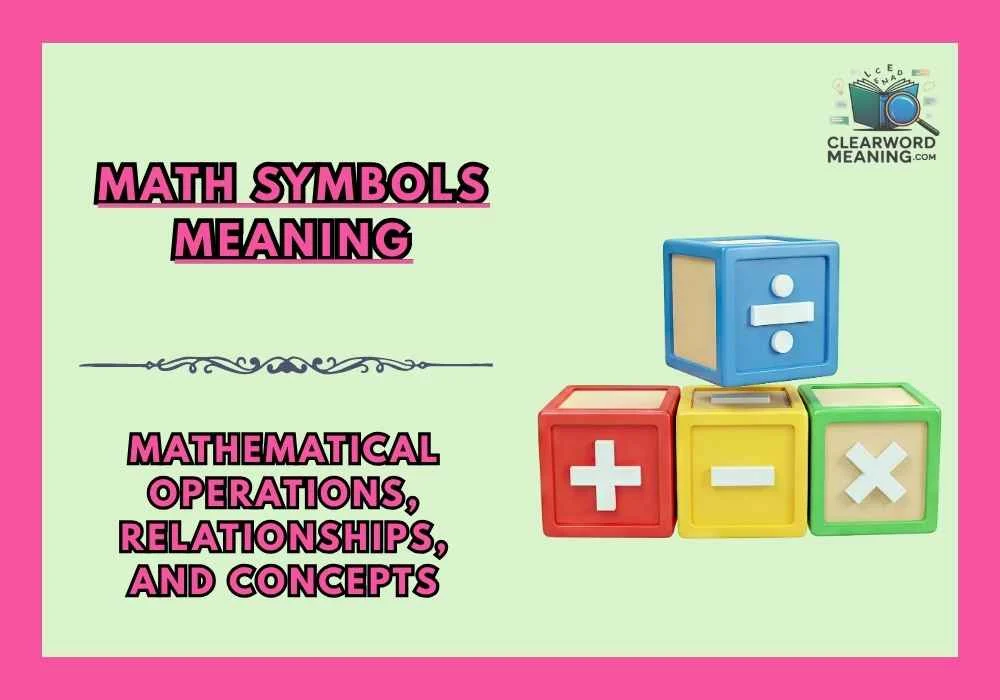
In the world of texting, chatting, and even in academic discussions, math symbols can often pop up unexpectedly. Whether you’re deciphering a friend’s casual text like “I scored >90% on my test!” or trying to understand online discussions in forums or social media, knowing the meaning of math symbols is more important than ever.
This guide will not only explain what each symbol represents but also give you practical tips on using them correctly in conversations. Updated for 2026, this article is your one-stop resource for mastering math symbols in both digital and educational contexts.
What Does “Math Symbols Meaning” Actually Mean?
Definition & Origin
Math symbols are shorthand representations of mathematical operations, relationships, and concepts. From the simple + for addition to the complex ∑ for summation, these symbols allow people to communicate numbers and formulas quickly.
Many of these symbols have historical origins:
- + and −: First appeared in Europe in the late 15th century.
- = (equals): Introduced by Robert Recorde in 1557.
- ∞ (infinity): Coined by John Wallis in 1655.
Today, math symbols are used everywhere—from classrooms and textbooks to social media posts and casual texts. Understanding them can help avoid confusion and make your communication more precise.
How to Use Math Symbols in Texts or Chat
Using math symbols in texts or chats adds clarity, especially when sharing numbers, comparisons, or even fun expressions:
- + and −: “I got 10+ likes on my post!”
- > or <: “Your score > mine 😎”
- =: “Sleep + coffee = happiness”
- ∞: “Love you ∞ ❤️”
Tips for Using Math Symbols Correctly
- Keep it simple: Don’t overcomplicate a text with too many symbols.
- Know your audience: Some symbols may be confusing if the other person isn’t familiar with them.
- Combine with words for clarity: For example, “x² + y² = z²” works best in a math-focused discussion rather than casual texting.
Examples of Math Symbols in Conversations
Here are some real-life examples showing how people use math symbols meaning in everyday chats:
- Comparison: “My phone battery < yours after gaming 😅”
- Addition: “Weekend plans + pizza night = perfect combo!”
- Expression of infinity: “Friendship ∞ = priceless”
- Multiplication/Emphasis: “Excitement x1000 for the new movie!”
By seeing these examples, it’s easier to understand not only the symbol itself but also the tone or emotion it can convey.
Common Mistakes or Misunderstandings
Even simple math symbols can be misused:
- Confusing < and >: Using them backwards can change the meaning entirely.
- Using = incorrectly: Saying “I = tired” instead of “I am tired” might confuse readers outside of meme culture.
- Overusing symbols: Too many symbols can make your text look cluttered and hard to read.
Pro Tip:
Always think about whether your symbol adds clarity or just looks cool. If it doesn’t help your reader, skip it.
Related Slangs or Abbreviations
Math symbols often appear alongside internet slang:
- xD: Not a multiplication symbol—this is a laughing face emoji!
- ^_^ or ^.^: Used as cute expressions, not exponentiation.
- # (hashtag): Used in social media, sometimes mixed with numbers or symbols.
These combinations create a playful and relatable chat style that blends numbers, math, and emojis.
FAQs:
What does > mean in texts?
It usually means “greater than” and is often used in casual comparisons like “My coffee > yours.”
Can I use math symbols in social media captions?
Absolutely! Symbols like ∞, +, and − are trendy and make your posts more visually engaging.
Why do people use = in texting?
The = symbol can show results, comparisons, or even create meme-like expressions such as “Coffee + Sleep = Happiness.”
Are there symbols that are often misunderstood?
Yes, symbols like <, >, and x can confuse people if they aren’t familiar with basic math notation.
How do I learn all the math symbols quickly?
Start with the most common ones (+, −, =, >, <, ∞) and practice using them in daily texts. Over time, you’ll naturally pick up the less common ones.
Conclusion
Mastering math symbols meaning is not just for students—it’s for anyone who wants to communicate clearly and creatively in digital conversations. From casual texting to social media posts, understanding these symbols helps you express ideas faster and with more impact.
Remember, the key is to use symbols wisely: don’t overcomplicate, know your audience, and always aim for clarity. By integrating math symbols into your digital language, you can make your chats more fun, relatable, and precise.

I am the author, Brook, dedicated to creating clear and reliable content that informs and engages readers. With a passion for well-researched and valuable information, I focus on delivering content that is both easy to understand and practical. My goal is to build trust with my audience by providing consistent, accurate, and meaningful material. Whether writing for beginners or experts, I strive to make every piece insightful, engaging, and impactful.